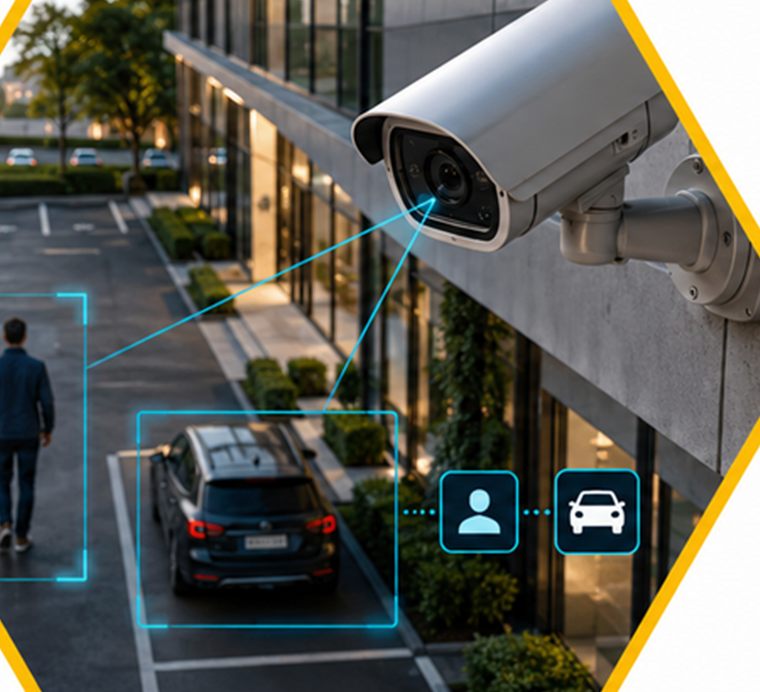
The real test of a camera system is not whether pictures appear on a monitor. It is whether you can find the right incident, understand what the images show, export the file promptly and explain how it was handled. We design for that outcome, which means thinking about image quality, clocks, retention, access and export before a single camera goes up.
What we install
- Full IP camera systems, from a handful of cameras to installations of a hundred or more.
- Recorders and storage sized to the retention period the business actually needs.
- Cabling and switching on a proper gigabit network, with PoE and backup power.
- Remote viewing on phone, tablet and PC, secured with individual logins.
- Screens where people need them, such as reception and the manager's office.
- Point-to-point wireless links for cameras far from the nearest building.
- Maintenance, and retrofit work on existing camera infrastructure.
What AI on a camera actually does
In most commercial systems, AI means software that classifies objects, applies rules and makes events searchable: telling people from vehicles, detecting movement across a virtual line, alerting when someone stays in a restricted zone, searching recordings by event, and reading number plates where the camera and the scene are designed for it. It reduces nuisance alerts, but it can also miss genuine events, and it does not understand intent. The buying question is not which AI camera to purchase, but which event must be detected, under what conditions, who verifies it and what happens next.
Evidence readiness
Businesses discover too late that the image lacked detail, the recorder clock was wrong, the footage had already been overwritten, or the exported file plays only in unfamiliar proprietary software. We set systems up so an ordinary authorised person can retrieve and export an incident without calling us, and we recommend a short monthly test to prove it. Our CCTV Evidence Readiness report sets out that test.
POPIA
Footage that identifies people, vehicles or behaviour is personal information. It needs a clear purpose, controlled access, a justified retention period and reasonable safeguards. We build those into the design rather than leaving them for you to work out afterwards.
A hundred cameras at Riverside High School
128 channels, 100 full IP 4-megapixel cameras with audio, over 8 km of Cat 6 on a gigabit network, covering entrances, corridors, stairwells and classrooms, with remote access and screens at reception and in the principal's office. Installed in two and a half weeks.
Questions we are asked
Can you work with our existing cameras?
Often, yes. We retrofit to existing infrastructure where the cabling and cameras justify it, and tell you plainly where they do not.
Can we view the cameras from anywhere?
Yes, by app or web portal, with individual secure logins. You can view live or go back and export a recording.
How long is footage kept?
That is a design decision, based on how long your business realistically needs to look back, and it drives the storage. We size it deliberately rather than leaving it to whatever the recorder happens to do.
Our cameras recorded an incident but the footage was useless. Why?
Usually image quality at that distance, a wrong clock, retention too short, or an export nobody else can open. All four are avoidable, and all four are worth testing monthly.